At the end of every programme cycle, there exists data from beneficiary numbers to sessions delivered and surveys completed; the spreadsheets are full. The work, then, is that someone must turn all of it into a donor report that will determine whether that donor funds the next cycle or not.
Most donor reports treat data presentation as the goal, which it is not. The goal of the report is to make a donor feel, with evidence and honesty, that their money did something that mattered. Data is the raw material for that feeling. It is not the feeling itself. The difference between a report that retains a donor and one that technically satisfies a reporting requirement is almost entirely in the writing, and here is how to close that gap.
Start with what changed, not what happened
The most common structural failure in donor reports is that most open with activities. The activities, which could be workshop dates or materials produced, are the things that are easiest to report because they are most directly observable, but they are also the least interesting things to a donor who is trying to understand whether their investment produced value.
Activities show what the programme did, but outcomes show what changed because it took place. The distinction is simple, but it requires a deliberate choice at the start of the report: begin with what is now different in the world, or in a specific community, because of the work.
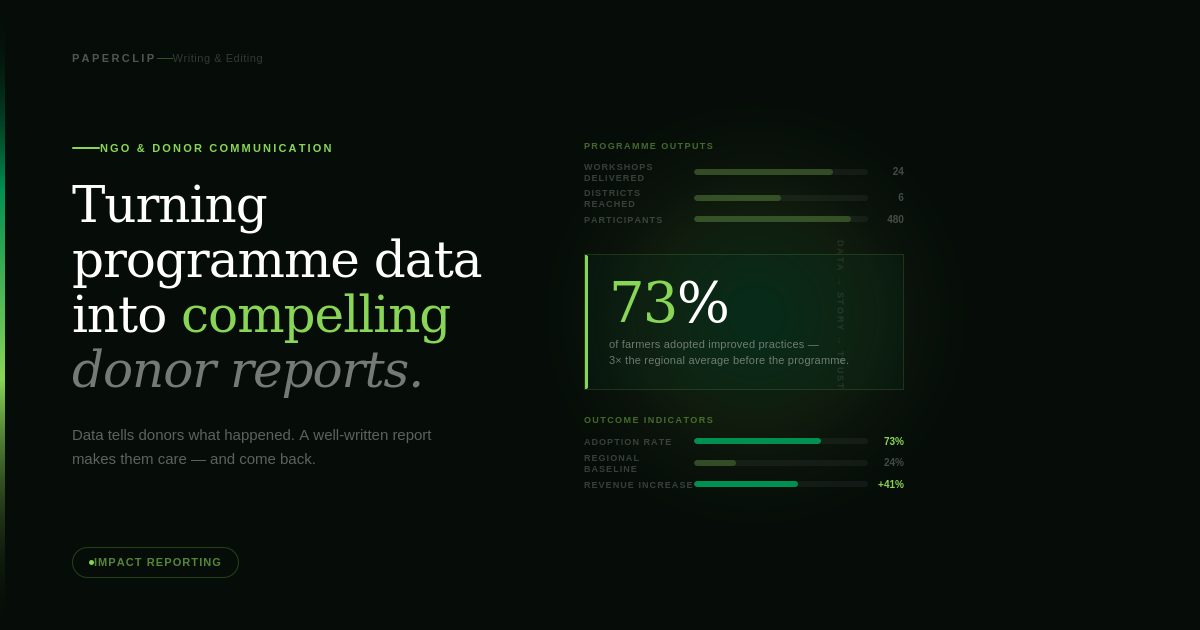
An opening that reads "During the reporting period, the programme delivered 24 workshops across 6 districts, reaching 480 participants" tells a donor what their money purchased while an opening that reads "By the end of the programme cycle, 73% of participating farmers had adopted at least one improved soil management practice a rate three times higher than the regional average before the programme began" tells them what their money changed. The second opening creates a context in which every piece of activity data that follows becomes evidence for a claim, rather than a list of things that occurred.
The three questions every donor is asking
When a programme officer reads a donor report, they are implicitly asking three questions. Explicit answers to all three are what separates reports that build confidence from reports that merely satisfy requirements.
Did the money reach the people it was supposed to reach?
This is the basic accountability question, and it is answered through output data: numbers reached, demographics, geographies, and targeting criteria met. Most reports answer this question adequately, but the mistake here, however, is treating it as the only question and so writing a report that is essentially a detailed answer to this one enquiry while neglecting the other two.
Did anything change because of the programme?
This is the outcome question, and also where most reports fall through. The answer to this requires pre- and post-data, or at a minimum, credible qualitative evidence of change. If you do not have a control group, say so and explain what you do have instead. Donors who have read enough reports can identify when outcome claims are inflated, and honesty about the limits of your evidence is more confidence-building than overreach.
If outcomes were not what was expected, report that too, whilst explaining what you learned and what it implies for programme design going forward. A donor who reads that an organisation encountered unexpected results, adapted its approach, and can articulate what it now understands that it did not before is reading about an organisation they can trust with future funding. A report that implies everything went exactly to plan is, to an experienced reader, a report that is not being fully honest.
Was this organisation the right one to do this work?
This is the credibility question, and it is answered implicitly throughout the report — through the quality of analysis, the specificity of evidence, the honesty about challenges, and the rigour of financial reporting. But it can also be addressed directly through a section on organisational learning: what this programme cycle taught the team, what has been changed as a result, and how the organisation is better positioned to deliver the next phase.
Donors make funding decisions partly on programme merit and partly on organisational trust and the report is one of the primary mechanisms through which that trust is built or eroded.
Using case studies without exploiting them
A well-chosen case study does more work in a donor report than any amount of aggregate data. It makes impact tangible. It gives the donor a person, a situation, a before and an after, and that specificity is what creates the emotional investment that data alone cannot.
The craft is in the selection and the writing. Select a case study that is representative, not exceptional for example, the story of someone whose experience was typical of the programme's effect, not the single outlier who achieved the most dramatic outcome. An atypical case study reads as cherry-picking to a sceptical programme officer and undermines the quantitative evidence rather than supporting it.
Write case studies with the same discipline as the rest of the report. Name the person if they have consented to be named. Be specific about the situation before the programme, specific about what changed, and honest about what remains difficult. A case study that resolves too neatly signals that it has been edited to a conclusion rather than reported accurately.
Practice check: Read your case study back and ask: Does this person sound like a real human being in a real situation? Or does it sound like a testimonial written to support a predetermined conclusion? If the latter — rewrite it.
The financial section is not a formality

Most organisations treat the financial section of a donor report as an administrative requirement — the numbers that have to be there to satisfy compliance. Donors read it differently. The financial section is where they look for evidence that the organisation manages money with the same rigour with which it claims to manage programmes.
Variances between budget and actual spend should be explained, not just presented. An underspend is not necessarily a failure — but it requires an explanation of why it occurred and what it means for programme delivery. An overspend requires the same. Line items that look unusual to an external reader should be footnoted. The goal is not to justify every decision but to signal that every decision was made consciously.
An organisation whose financial reporting is meticulous, transparent, and well-explained is one that a donor trusts to scale. Careless financial reporting — numbers without narrative, variances without explanation — is one of the quietest but most effective ways to lose a long-term funding relationship.
Length, format, and the reader's time
Donor reports are rarely read from cover to cover on a first pass. A programme officer managing a portfolio of grants will scan for the key information, form an initial impression, and return for detail on the sections that raised questions. Your report should be designed for that reading pattern.
Use clear, descriptive headings that function as a navigation system. Put the most important finding — the one that most directly answers the question "did this work?" — as close to the front as the report structure allows. Use an executive summary not as a formality but as a genuine distillation of the report's argument: what was done, what changed, what was learned, and what comes next.
Write for the reader who has twenty minutes, not the reader who has two hours. If the report is longer than it needs to be, it is not thorough — it is inconsiderate of a reader whose time and attention are the scarcest resources in the relationship.