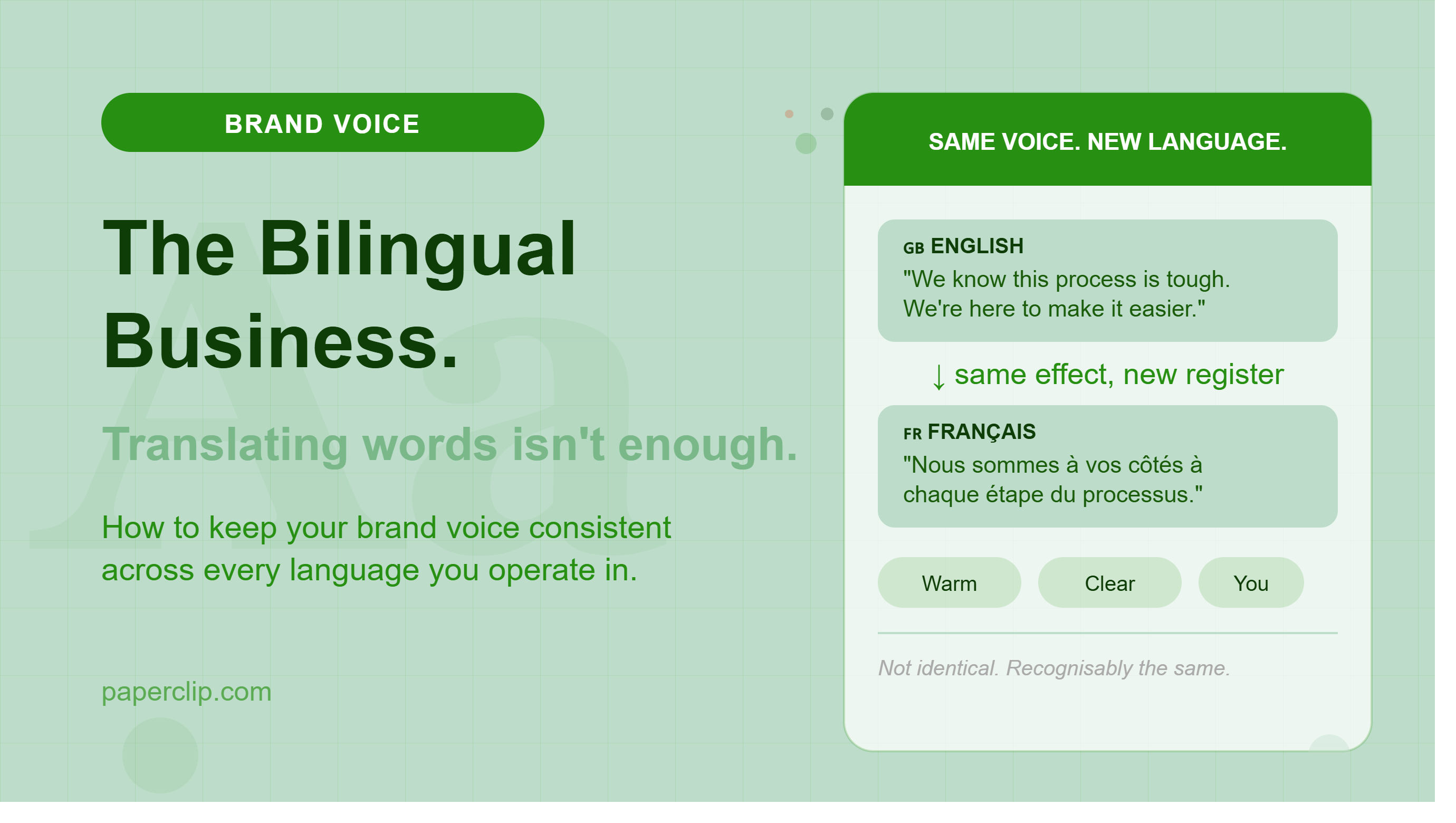
When a company expands into a new language market, the instinct is to focus on accuracy. Does the translation say the right thing? Are the technical terms correct? Is the grammar sound? These are legitimate concerns as they are addressable and a competent translator resolves them.
What competent translation does not automatically resolve is your brand voice. The tone your brand uses to speak to its audience, the rhythm of the sentences and the level of formality you strike. The specific quality of warmth, or authority, or wit that distinguishes your communications from everyone else operating in your space. These things can survive translation, but they require deliberate effort to preserve, and most companies do not make that effort until they notice that something has been lost.
The companies that manage multilingual communication most effectively understand that they are not just translating documents but a relationship, the relationship between the brand and its audience, into a new cultural and linguistic context. That is a fundamentally different brief.
Your brand voice is the effect your words have on the people who read them. Translating the words without translating the effect is how companies go multilingual and lose themselves in the process.
What brand voice is and why it is hard to translate
Brand voice is usually described in terms of adjectives: bold, warm, authoritative, conversational, expert, and approachable. These descriptors are useful for internal alignment, but they are not translatable because they describe how the writing should feel, not how to produce that feeling in a specific language.
The way you produce the feeling of "warmth" in English is not the same as the way you produce it in French, Spanish, or Zulu. English warmth often lives in contractions, short sentences, and direct address — "we know how hard this is" rather than "it is understood that this process presents challenges." French warmth operates differently: through a kind of considered attentiveness that, if rendered too informally, tips into presumption. Spanish warmth is often more openly relational; Zulu warmth is often expressed through implication and restraint rather than explicit statement.
A translator who is working without a brand voice brief will make choices that are linguistically accurate and culturally reasonable, but they will make different choices than another translator working on the same material. Over time, across multiple translators and multiple document types, those individual choices accumulate into an incoherent brand: technically correct in every language, distinctly itself in none.
The three places voice gets lost
In the formality register
Every language carries a spectrum of formality, and decisions about where on that spectrum to position your brand are consequential. A brand that has deliberately adopted a plain, direct, low-formality register in English faces a genuine question when moving into French, where the formal/informal distinction carries strong social implications, or into German, where professional communication has historically operated at a higher formality register than equivalent English.
There is no universally correct answer to these questions. The answer depends on your specific audience, your category, and how your brand is positioned in each market. What matters is that the answer is made deliberately as a brand decision, rather than by default, through whatever choice individual translators happen to make.
In the handling of humour and tone
Humour is the hardest element of brand voice to translate, because it is the most culturally embedded. Irony, understatement, and self-deprecation, which are common features of British and some American brand voices, do not transfer cleanly across most language boundaries. What reads as gently ironic in English may simply read as unclear in a direct translation. What reads as charmingly self-deprecating may read as insecure.
This does not mean multilingual brands cannot be warm or witty. It means that the specific mechanisms of warmth and wit need to be reconsidered for each language context. The goal is not to produce the same words in different languages but to produce the same effect on different audiences, and this sometimes requires significantly different writing.
In technical and specialist content
Brands that operate in specialist sectors like legal, financial, medical and development face a particular challenge in multilingual communication. The same content needs to be technically accurate for a specialist audience while remaining accessible for a general one, and this balance is calibrated differently in different languages and professional cultures.
German professional communication, for example, tends to tolerate higher levels of technical specificity than equivalent English communication directed at similar audiences. French professional culture places a high value on conceptual precision. All these affect how content should be structured, how much context should be provided, and what level of assumed knowledge is appropriate.
How to build a multilingual voice framework
The companies that manage this best have done a piece of work that most do not: they have built a multilingual brand voice framework, which is a document that articulates the brand's voice not just in the source language but in terms that can be operationalised across languages.
This framework typically includes:
Voice principles that describe effect, not just style. Rather than 'conversational', a principle like 'treats the reader as an intelligent peer who doesn't need to be patronised' travels better across languages because it describes the goal rather than the mechanism.
Language-specific guidance for each active market, produced in collaboration with native-speaking translators and local communications professionals who understand both the brand and the cultural context.
Glossaries of key brand terms in each language, not just translations, but the specific words and phrases that best carry the brand's intended meaning in each context, along with terms to avoid.
Worked examples: side-by-side comparisons of source content and target-language versions, with annotations explaining key choices. These are invaluable for onboarding new translators and maintaining consistency when translation is distributed across multiple providers.
This is not a small piece of work. For businesses operating across three or four languages, building a proper multilingual voice framework typically requires three to six months of investment in its first iteration. But the alternative, which is inconsistent voice across markets, repeated rework, and a brand that sounds like a different company in every language, costs more in aggregate and is far harder to fix retroactively.
The working relationship between brand and translator
Much of the failure in multilingual brand communication comes from a poorly written brief, and so translators who receive content without making reasonable default choices. Those choices are often not the choices the brand would have made.
The most effective multilingual communications teams treat their translators as communications partners rather than as conversion tools. They share brand voice guidance before work begins and provide context for every piece of content: who it is for, what they should feel after reading it, and what they should do. They create feedback loops so that translators can flag places where a direct approach is creating cultural friction and propose alternatives.
This working relationship is harder to establish and maintain than a transactional translation workflow, but it produces fundamentally different output. The difference is the difference between content that is linguistically correct and content that works.
A final note on consistency and adaptation
Maintaining a consistent voice across languages does not mean producing identical communications in every market. Some adaptation is a recognition that the same relationship can be expressed differently in different cultural contexts, and that insisting on identical expression across all contexts is itself a form of cultural insensitivity.
The goal for this is recognisability. A client who encounters your brand in English, then in French, then in Spanish, should feel — across all three — that they are dealing with the same organisation: one with a clear identity, a coherent set of values, and a consistent way of engaging with the people it serves.
Getting there requires investment, collaboration, and an ongoing commitment to treating multilingual communication as a strategic priority rather than a logistical one. But it is the standard that distinguishes truly international brands from businesses that happen to have content in multiple languages.