Midway through the year is when most businesses pause to check their numbers. From revenue against targets to pipeline against projection, these reviews are expected and very useful. However, what almost no business does at the same time is check the documents. Yes, the documents which act as major communication materials for your business, no one checks them.
These documents are not static records of what your business was at the time of writing, but rather are active representations of what your business is right now to clients, investors, partners, and potential hires. When the business evolves and the documents do not, the gap between what you say and what you do becomes visible to everyone except the people inside the organisation.
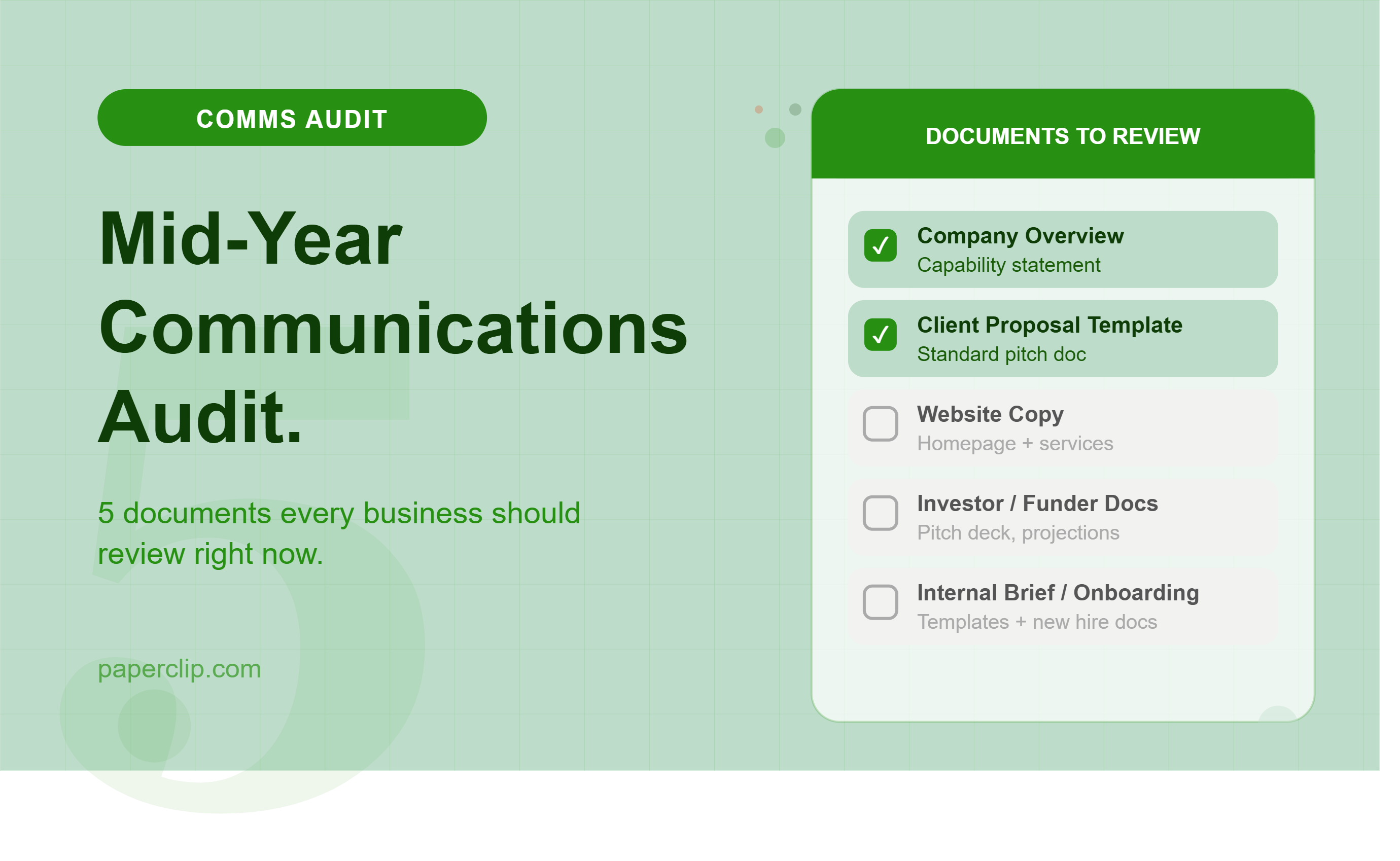
A mid-year communications audit is an important business hygiene exercise, and here are the five documents that most commonly drift out of alignment and the specific questions to ask when you review them.
Your documents are making an argument about your business every time someone reads them. The question is whether that argument is still accurate.
1. Your Company Overview or Capability Statement
This is the document that most frequently goes stale, because it is the one most frequently sent out. Proposals, partnership enquiries, and investor introductions all attach or link to some version of a company overview. Which means that when it is out of date, the outdated version is the one circulating most widely.

Mid-year, ask these questions of your overview:
Does it reflect your current service offering, or does it still describe a version of the business from six or twelve months ago?
Have you added clients, sectors, or geographies that should be represented?
Does the tone and positioning still match how you describe the business verbally in meetings?
Are the credentials and case studies the best available examples of your work, or just the ones that were available when the document was first written?
A capability statement populated with your oldest work, because that is what existed when the template was built, undersells a business that has grown. The best work you have done is the most recent work you have done, so make sure the document reflects that.
2. Your Standard Client Proposal Template
Proposals are closed documents in the sense that they go out and rarely come back with annotations. Which means you may not know that your proposal template is losing you work, as you only see the wins, and not the friction points in the document that the client never mentioned.
At mid-year, pull your last five to ten sent proposals and read them as a first-time reader would. Specifically:
Is the problem statement specific enough to signal that you understand this client's situation, or is it generic enough to have been sent to anyone?
Is the scope of work clear enough that a client could explain it to a colleague without your help?
Does the pricing section explain the value being delivered, or just state a number?
Is there a clear, specific next step at the end — or does the proposal simply stop?
The single most common proposal failure is a vague scope of work that makes the client feel uncertain about what they are buying. Uncertainty at the proposal stage produces hesitation, which in turn produces delay and delay produces competitors.
Audit question: Read your last proposal aloud from start to finish. Every sentence that makes you want to skip ahead is a sentence that should be rewritten or cut.
3. Your Website Copy
Website copy is written once and then largely forgotten, which means it is quietly diverging from the business every day. At mid-year, the specific question is not whether the design looks dated but if the words are still true.
Check the homepage against your current positioning. If someone read only your homepage, would they understand what your business does, who it does it for, and why that matters? Most homepages fail this test because they were written to describe a business at launch, not the business as it has matured.
Check the services pages against your current offering. Services that have been refined, expanded, or discontinued should be reflected in the copy, not just in internal knowledge. Clients who land on a services page describing something you no longer offer exactly as described are not going to call and ask for clarification.
Check the social proof from testimonials, case studies and client logos against what is most compelling right now. A testimonial from three years ago from a client relationship that has since deepened is a missed opportunity.
4. Your Investor or Funder-Facing Documents
For businesses that are fundraising or that maintain relationships with investors or funders between rounds, the documents that represent the business to that audience need particular attention at mid-year.
Financial projections should reflect any significant movement in revenue, pipeline, or cost structure since the last version was produced. An investor who receives a pitch deck with projections that are clearly out of step with the business's current trajectory will all but assume the discrepancy is innocent; they will assume the business is not tracking its own performance carefully.
The narrative sections of investor documents, from the problem statement, market opportunity, and competitive positioning, should be reviewed against what has changed in the external environment. Due to the fact that markets shift and regulatory contexts evolve, a pitch deck written in January that does not account for material changes in the landscape by July is potentially misleading.
For NGOs and funded organisations, mid-year is also the moment to review donor reports in progress against the commitments made in original proposals. The gap between what was promised and what is being delivered — in language, framing, and data — is most efficiently addressed before the final report is due, not during it.
5. Your Internal Brief or Onboarding Template
Internal documents are the ones businesses are least likely to audit, and among the ones most likely to be causing quiet damage. A brief template that does not reflect how work is scoped and delivered produces lots of confused projects. An onboarding document that describes a company culture or process that has since changed produces new hires who feel deceived when reality does not match the document.
At mid-year, pull the document that a new client receives when a project begins, and the document that a new employee receives in their first week. Ask whether those documents represent the organisation as it operates today. If the answer is no, which it might be, that is enough information to know how well the audit is working.
How to run the audit without it becoming a project
The most common reason communications audits do not happen is that they feel like large projects, but they do not need to be. A focused half-day — one person, the five documents listed here, and a shared document for notes — is enough to identify the gaps. The editing and rewriting that follows is a separate task, scoped separately.
The goal of the audit is to know which documents are misrepresenting your business, so you can prioritise fixing the ones that are doing the most damage. Treat your communications materials as living assets as they also require the same periodic maintenance as any other system your business depends on. The businesses that do this well rarely need to do it urgently, because they never let the gap get wide enough to matter.