Most impact reports are written for compliance purposes where they document what was done, how much it cost, and roughly how many people were involved. They are mostly accurate, thorough, and almost entirely forgettable.
This is a significant missed opportunity, particularly for ecosystem support organisations (ESOs), which operate in a space where investor interest in social and economic impact has never been higher. Impact investing has grown into a multi-trillion-dollar asset class. Patient capital, blended finance, and mission-aligned investment are no longer niche conversations, and this infrastructure exists for ESOs to attract serious investment. The bottleneck, more often than most organisations realise, is the document they are using to make the case.
An impact report that reads like an operational log does not serve an investor audience. It answers the question "what did you do?" when investors are asking "what changed, for whom, because of you, and can I trust that?"
Data is the raw material. The story is what gives the data its meaning.
What investors are looking for
Investment into ESOs, whether from development finance institutions, family offices, corporate social responsibility programmes, or impact funds, is evaluated on two dimensions: financial viability and impact credibility.
Financial viability is addressed through the usual channels: audited accounts, financial projections, governance documentation and related compliance materials. But impact credibility is where many ESOs underinvest in their communication and where the best-designed impact reports do the most work.
Impact credibility means convincing an investor of three things: that the problem you are addressing is real and significant; that your intervention is causally connected to the outcomes you are claiming; and that your organisation has the institutional capacity to replicate and scale what it does. A data-heavy report can establish the first and gesture at the second. A report that tells a coherent story can establish all three.
Lead with the problem, not the programme
Most impact reports open with an organisational overview: who we are, what we do, how long we have been doing it. Investors already have this information or can find it, easily. What they need to see first is that you understand the landscape you are operating in and that the problem you are addressing has the kind of growth and urgency that justifies investment.
A strong opening paragraph for an impact report situates the problem in evidence: the scale of the gap, who is most affected, and why existing approaches have not been sufficient. This is framing that tells the investor your organisation sees the problem the way they do.
Show the change, not just the activity
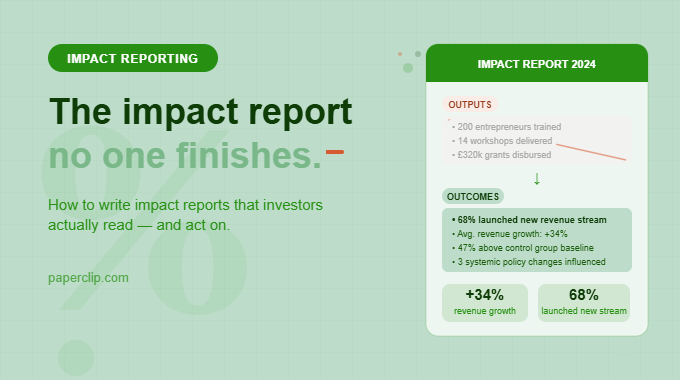
The most common structural failure in impact reports is presenting outputs as if they were outcomes. Outputs are countable: workshops delivered, entrepreneurs trained, and grants disbursed. Outcomes are the changes that outputs produce: businesses launched, jobs created, revenues grown, systems changed.
Investors fund outcomes, not outputs. The output data belongs in the report; it demonstrates operational delivery, but it should always be connected to the outcome it was designed to produce. If you trained 200 entrepreneurs, the question the report needs to answer is: what happened to those entrepreneurs? What changed in their businesses? What would not exist without your intervention?
Use the theory of change as your narrative spine
A theory of change is the causal logic connecting your activities to your intended outcomes, not just an accountability tool. It is the structural backbone of a compelling impact narrative, and when you write your report around it, you force every section to answer the same question: Does this evidence support the causal claim we are making?
This approach also signals institutional maturity to investors. An organisation that can articulate its theory of change clearly and acknowledge where results diverged from expectations is one that understands what it is doing and can be trusted to learn from it.
Let beneficiaries speak
Quantitative data establishes scale, but qualitative evidence from case studies and direct testimony to longitudinal profiles establishes meaning. The most effective impact reports use both in deliberate proportion: enough data to establish credibility, enough story to create conviction.
A well-chosen case study does something that a table of outputs cannot: it makes the impact tangible. The reader encounters a specific person, in a specific situation, whose life or business changed in a specific way because of your work. That specificity is what remains after the report is closed.
The language of investor-facing impact reporting
Tone and register matter a lot in investor-facing documents. The language that works well in a community newsletter, which could be warm and conversational, needs to be calibrated when the audience includes investors doing due diligence.
This does not mean becoming cold or technical, but being precise. Avoid vague impact language: "improved livelihoods", "strengthened communities", "transformed futures". Replace it with claims that can be verified: "47% of participating businesses reported a revenue increase of at least 20% within six months of completing the programme, against a control group growth rate of 9%."
Investors have read enough impact reports to recognise when language is being used to obscure rather than communicate. Specificity builds more trust than sweeping claims.
The report as relationship-building tool
An impact report that is written for investors is not just a compliance document or a fundraising instrument. It is a relationship-building tool. It communicates values, demonstrates transparency, and signals the kind of partner your organisation will be. The ESOs that attract patient, long-term investment are often those whose reporting gives investors confidence over time in the organisation's willingness to share what did not work alongside what did. This is the kind of transparency investors notice.
Reframing your impact report as a story means organising the evidence around a narrative that answers the questions investors are genuinely asking and doing so in language that respects their intelligence and time.
The investment is out there. The question is whether your report is the document that brings it in.