Most CVs read like a job posting written in the wrong direction. Where a job posting says what the employer needs, a duty-based CV says what the candidate was responsible for and the reader, who already knows what a marketing manager does, learns almost nothing.
Hiring managers and recruiters spend an average of seven seconds on an initial CV scan. In that window, they are not looking for a comprehensive record of your employment history; rather, they are looking for evidence that you can do the specific job they need done and do it well. A plain list of duties provides neither.
The problem is not that candidates are underqualified, but rather that they describe their careers in a way that hides the most persuasive information: what they have actually achieved.
A CV is not an archive. It is an argument, and the argument is that you are the best person for this role.
Duties vs. value: what the difference looks like
This distinction is clearest in an example.
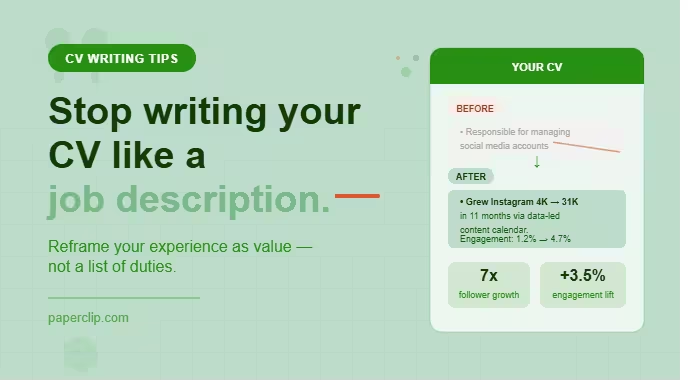
Duty-based: "Responsible for managing the company's social media accounts and developing content strategies."
Value-based: "Grew Instagram following from 4,200 to 31,000 in 11 months by building a content calendar around audience data. Engagement rate increased from 1.2% to 4.7%."
Both describe the same role, but one tells the employer what you were supposed to do and the other tells them what happened because you were doing it. The second version answers the question every hiring manager is asking: if I bring this person in, what will change? This reframing is more about precision, not exaggeration. Most professionals have achieved more than their CVs suggest; they simply have not written it down in a way that communicates their achievements clearly.
Why duty-based CVs feel safer
Many professionals default to duties because it feels accurate. They list their past responsibilities and believe they are being honest, which they are, but accuracy is not the same as persuasiveness, and a CV is meant to be a persuasive document.
There is also the anxiety of quantification. What if the numbers are not impressive enough? What if the achievements are hard to measure? These are real concerns, but they have solutions. Not every achievement needs to have a clean metric. Some are qualitative: you simplified a process that others found confusing or managed a relationship that was close to breaking. You delivered a project that had been stalling for six months. These are achievements, and they belong on your CV, framed as outcomes, not activities.
The instinct toward duty-based writing also reflects a misunderstanding of what hiring managers value. They do not want to know that you were responsible for a team of eight; they want to know what that team produced. They do not want to know that you managed client relationships; they want to know whether those clients stayed.
How to rewrite your CV: a practical approach
Start with the outcome, then work backwards
For each role, ask: what was measurably different because I was here? Begin your bullet points with the result, then explain how you achieved it. This is the reverse of how most people write, and it is far more compelling.
2. Use the formula: result + context + method
Strong CV bullet points tend to follow a consistent structure, even if they do not state it explicitly: what changed (result), in what conditions (context), and through what approach (method).
Example: "Reduced client onboarding time from 14 days to 6 by redesigning the intake process and training the support team on the new workflow." Result: 8-day reduction. Context: onboarding. Method: process redesign and training.
3. Quantify where you can, and qualify where you cannot
Numbers are powerful, but they are not always available. When they are not, use relative language that still conveys direction: "significantly reduced", "consistently delivered above target", "first in the department to implement". These are less specific than figures, but they are still more informative than a neutral duty statement.
4. Cut the filler phrases
Phrases like "responsible for", "assisted with", "involved in", and "worked on" are among the weakest constructions in CV writing. They describe proximity to work, not authorship of results. Replace them with active verbs that specify what you actually did: built, led, launched, negotiated, cut, grew, resolved.
5. Tailor to the role
A value-focused CV still needs to be relevant. The achievements you surface should mirror what the job posting signals is important. If the role emphasises growth, lead with growth metrics. If it emphasises leadership, lead with team outcomes. SEO for a CV works the same way as SEO for a webpage: relevance to the query is what gets you ranked.
What your CV should feel like to read
A strong CV creates a specific effect in the reader. Each role produces a picture of someone who arrived, assessed a situation, did something concrete, and left things measurably better. That picture accumulates across the document. By the time the reader finishes, they should have a clear sense of what kind of professional you are, what kinds of problems you solve, and what they can expect if they bring you in.
That is a completely different reading experience from a list of duties, and it is the difference between a CV that gets a response and one that gets filed. The reframe is not complicated. It requires honesty, specificity, and the willingness to claim your own work. Most professionals have achievements. The task is to write them down in a way that makes them visible.